
CMMC Consulting for Defense Contractors
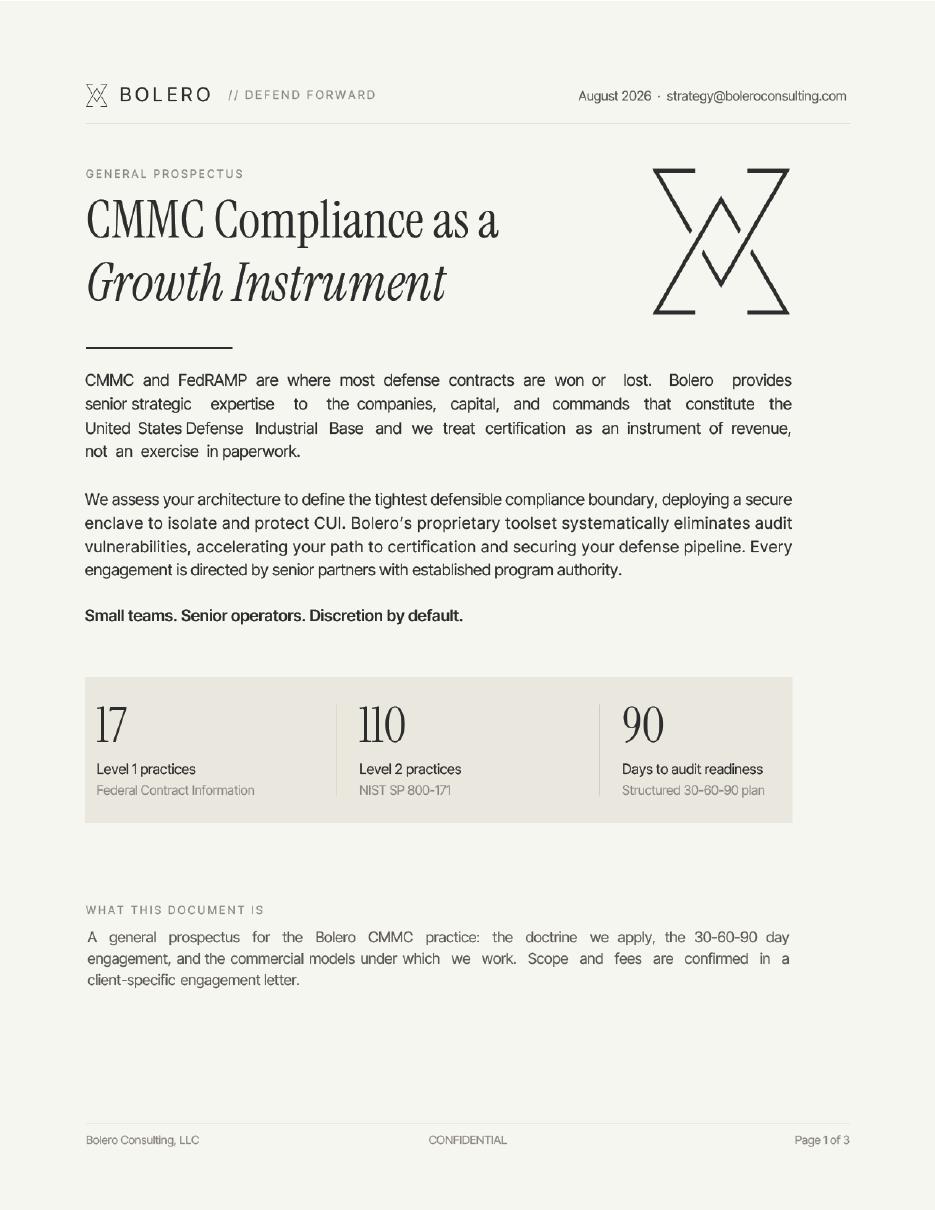
CMMC decides who is allowed to bid. We assess your environment against NIST SP 800-171, close the gaps that fail an assessment, and get you to CMMC Level 2 readiness so contract eligibility stops being the thing that holds your pipeline back.

Compliance is now a condition of award.
The Cybersecurity Maturity Model Certification program applies the safeguarding requirements the Department of Defense has expected for years, and it enforces them at the point of award. Contractors handling Controlled Unclassified Information need a certification that matches their contract clauses before they can compete.
We work the problem the way the assessment does: scope first, architecture second, documentation last. That order keeps remediation spend narrow and keeps you from certifying an environment far larger than your contracts require.
How a CMMC engagement runs.
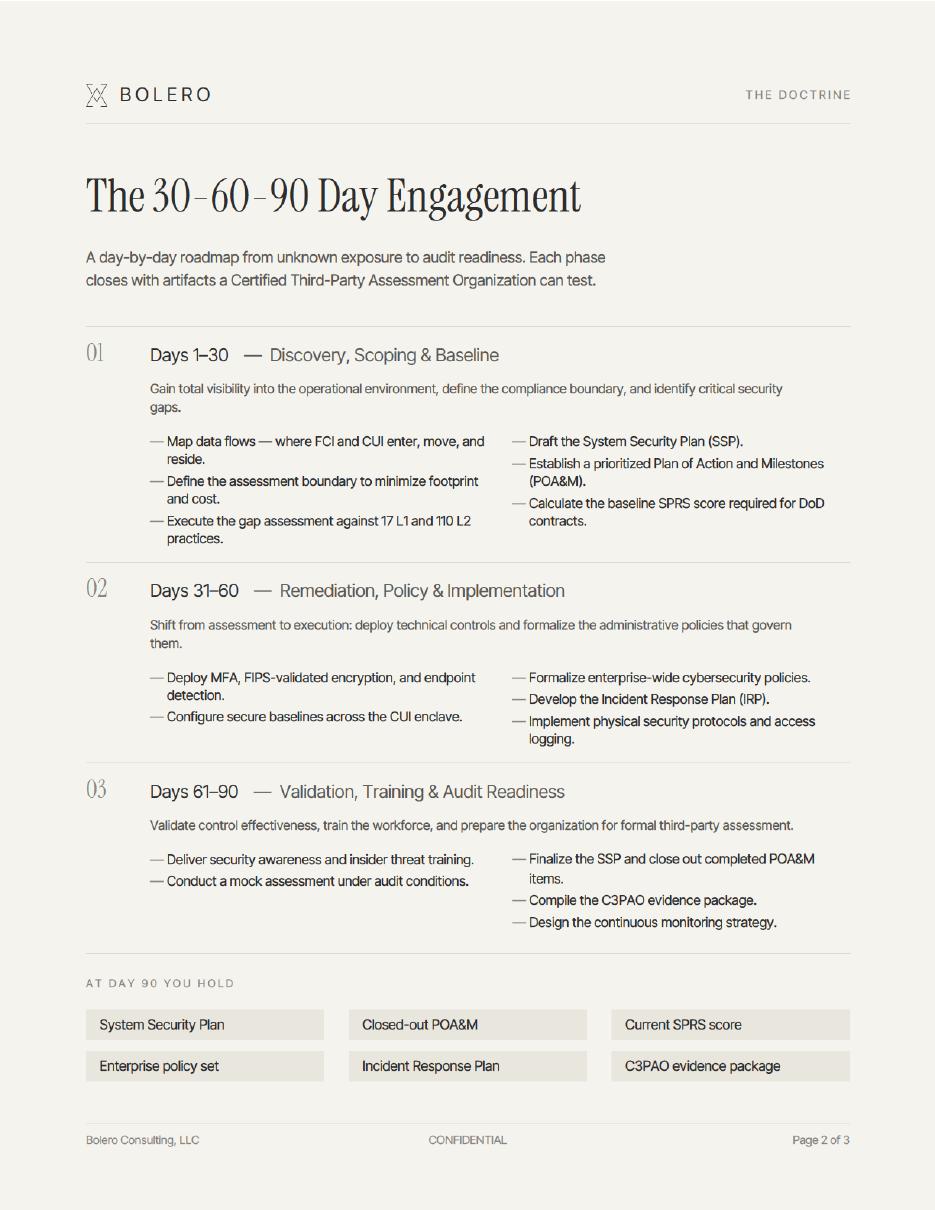
Scope and gap assessment
We start with your contracts. We identify the clauses that bind you, map where Controlled Unclassified Information actually lives in your environment, and assess the 110 NIST SP 800-171 controls against what you can prove today. You get a gap register with severity, effort, and the sequence to close it.
- /Contract clause and CUI flow-down review
- /CUI data mapping and enclave boundary definition
- /NIST SP 800-171 control-by-control gap assessment
- /SPRS self-assessment score validation
Remediation and enclave design
Most failed assessments are architecture problems, not paperwork problems. We narrow the boundary so fewer systems touch CUI, then close the gaps that matter: access control, FIPS-validated encryption, logging, multifactor authentication, and configuration baselines your team can actually sustain.
- /CUI enclave and boundary hardening
- /Access control, MFA, and FIPS-validated encryption
- /Audit logging and continuous monitoring buildout
- /GCC High and cloud service provider alignment
Documentation and evidence
Assessors score evidence, not intent. We build the System Security Plan, the Plan of Action and Milestones, and the policy and procedure set that back every control, then assemble the artifact package an assessor will ask for before they ask for it.
- /System Security Plan (SSP) authoring
- /Plan of Action and Milestones (POA&M) build
- /Policy, procedure, and control-narrative set
- /Evidence library and artifact indexing
Assessment support and sustainment
We run the mock assessment, fix what it surfaces, and stay with you through the C3PAO engagement. After certification, we keep the program current as personnel, systems, and the rules change, so your next assessment is a review rather than a rebuild.
- /Mock assessment and remediation sprint
- /C3PAO assessment preparation and support
- /Annual affirmation and score maintenance
- /Subcontractor and supplier flow-down compliance
CMMC compliance as a growth instrument.
We treat certification as an instrument of revenue, not an exercise in paperwork. We define the tightest defensible compliance boundary, isolate CUI inside a secure enclave, and close the audit vulnerabilities that stall your defense pipeline.
What Level 2 actually requires.
The full NIST SP 800-171 Rev 2 control set, assessed across 14 families, with no partial credit for controls you cannot evidence.
Level 2 certification for most CUI contracts requires a third-party assessment by an authorized C3PAO, not a self-assessment.
Only a subset of controls may be deferred to a POA&M, and they must be closed within 180 days. The highest-weighted controls cannot be deferred at all.
A senior official affirms continued compliance each year in SPRS. Certification is a program to sustain, not a one-time audit.
Signals that you need help now.
- 01A new contract or solicitation carries DFARS 252.204-7021
- 02A prime is asking for your CMMC status before award
- 03Your SPRS score is negative, stale, or was never validated
- 04CUI has spread across your production network with no defined boundary
- 05A previous assessment or mock assessment found gaps you have not closed
- 06You are inheriting flow-down obligations you have not passed to your own suppliers
CMMC consulting, answered.
Which CMMC level does my company need?
Level 1 applies to contractors handling Federal Contract Information only. Level 2 applies to any contractor storing, processing, or transmitting Controlled Unclassified Information and requires the 110 controls of NIST SP 800-171. Level 3 applies to a narrow set of programs facing advanced persistent threats. The requirement is set by your contract clauses, so we read those before scoping any work.
How long does CMMC Level 2 readiness take?
Most companies need three to nine months from assessment to assessment-ready, depending on how much of the environment holds CUI and how much remediation and evidence work is outstanding. Narrowing the enclave that holds CUI is usually the fastest way to shorten that timeline.
Can a consultant certify my company?
No. Certification assessments are conducted by an authorized C3PAO. Our job is to prepare the environment, documentation, and evidence so the assessment succeeds, then support you through it.
Bring us your most complex compliance challenge.
A partner reads every inquiry and responds within one business day.